On behalf of the Mission Museum, Paul Voogt, the museum’s curator, conducted research into the provenance of a 19th-century Chinese tapestry. This led to the report A Mission Trophy from China. The impact of the past on the present (2026). That was interesting, but the unexpected discovery was even more so.
How a village in Limburg influenced the course of Chinese history
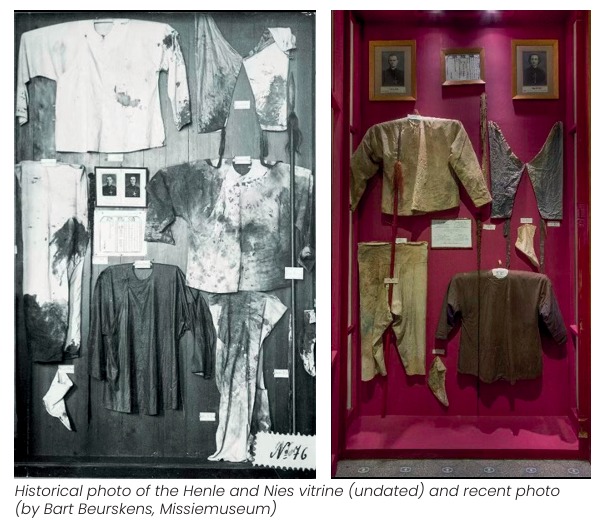
When Xi Jinping defends his foreign policy, he likes to refer to bǎinián guóchǐ, the ‘Century of Humiliation’. This was the period that began with the First Opium War (1839–1842) and ended with the founding of the People’s Republic of China (1949). One of the key moments in that history was the murder in 1897 of two Catholic missionaries, Richard Henle and Franz Nies. Their bloodstained clothes are still on display today in the Mission Museum in the Limburg village of Steyl. There, they are honoured as martyrs for the faith.
In another museum, however, it is the two perpetrators who are honoured: Liu Derun and Xi Laowu. They are the focus of a permanent exhibition at the museum in the city of Juye in China, not far from the site of the murder. They are commemorated as heroes of the anti-imperialist struggle.
The Juye Incident, as it is known in the history books, set in motion a series of events that radically altered the course of Chinese history.
The story in brief
In 1875, the German priest Arnold Janssen founded a new missionary order: the Societas Verbi Divini (SVD), the Society of the Divine Word. He was unable to do so in Germany, due to the Kulturkampf waged by Chancellor Bismarck against the Catholic Church. So he moved to a small town just across the German border. The monastery in Steyl remains the mother house of the congregation to this day. He sent his first missionaries to areas where Germany had colonial interests, such as the Chinese province of Shandong. There, Johann Baptist von Anzer took charge. Anzer was ambitious and carried out his missionary work in such an aggressive manner that it led to considerable resistance amongst the local population. One of his missionaries, Georg Stenz, had caused such a stir that an attempt on his life was plotted. However, when the attack took place, on the night of 1 to 2 November 1897, Stenz happened to have two colleagues staying with him: Henle and Nies. He had given them his bedroom for the night. This led to the ‘mistaken killing’ of Henle and Nies; they did not find Stenz.
Anzer happened to be in Steyl at the time and set off for Berlin at breakneck speed. Emperor Wilhelm had long been looking for a pretext to invade Shandong, and Anzer handed him that pretext on a plate. A large German military force embarked, and upon their departure, Wilhelm delivered his infamous ‘Hun speech’, in which he urged the soldiers to show no mercy. The port city of Qingdao was captured, the hinterland in Shandong was occupied, and the population was subjected to draconian reparations.
This was the spark that ignited the powder keg of the local militias, who unleashed a large-scale uprising. This ‘Boxer’ uprising was ultimately crushed by a coalition of imperialist powers; Beijing was sacked and bloody ‘punitive expeditions’ were undertaken. This heralded the end of the Chinese Empire.
Of particular interest are the mirrored images used by the two museums in their presentation of the Juye incident: the bloodstained and stabbed shirts and trousers of Henle and Nies at the Steyl Mission Museum, and the ‘Pepper’s Ghost’ animation of the murder at the Juye County Museum.
The current situation
Many of the churches and monasteries built by the SVD have been, or are currently being, restored and are once again being used by the official Catholic Church in China. This is the Church sanctioned by the Party; the ‘Roman’ Church operates underground. I spoke there with brothers and sisters who are wholeheartedly dedicated to researching the history of the SVD and bringing it to light, insofar as this is tolerated. Such as the Austrian Leopold Leeb, who teaches Greek and Latin at Renmin University in Beijing, but who primarily publishes on SVD history, and the Chinese Sister Guan (Sister Franziska), who is establishing a museum of SVD history at the Poli convent, on the very spot where the Party wishes to commemorate the history of an anti-imperialist attack on the convent.