Archive
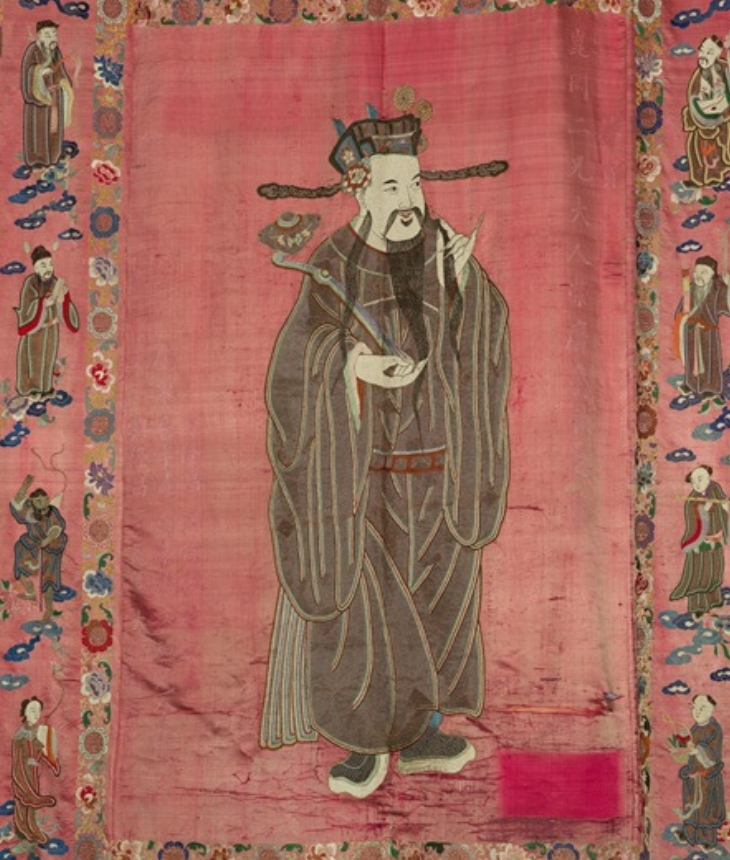
Chinese honorary tapestry
In the China display case at the Mission Museum hangs a so-called honour tapestry. According to the letter from missionary Volpert, which is affixed to the display case, he acquired this tapestry in 1901 in the town of Yanggu. The location and year of acquisition led us to suspect that this might be a case of looted art. Yanggu is situated in the south of Shandong province, where the SVD, the Steyl Missionary Society, had been active since 1879. Between 1899 and 1901, the Boxer Rebellion raged across this region, resulting in widespread murder and looting. Volpert had fled but returned in 1901. He writes that the carpet was made in honour of the 19th-century military leader and administrator Tianjue Zhou, a historical figure who is still well known in China today. It was not uncommon for such a carpet to be placed in the grave following a person’s death. Could Zhou’s tomb have been broken into and plundered? And could the carpet subsequently have been offered for sale to the missionary? This provided every reason to launch a provenance investigation, first in the archives and then by examining the carpet itself. By illuminating the carpet with raking light, we discovered text in (faded) Chinese characters. We then carried out research in China, in southern Shandong. We spoke to Tianjue Zhou’s biographer, experts on the history of the SVD in the region, and textile experts from the Shandong Provincial Museum. This yielded some surprising findings. The final report, containing all the conclusions, will be published shortly. Keep an eye on this website.