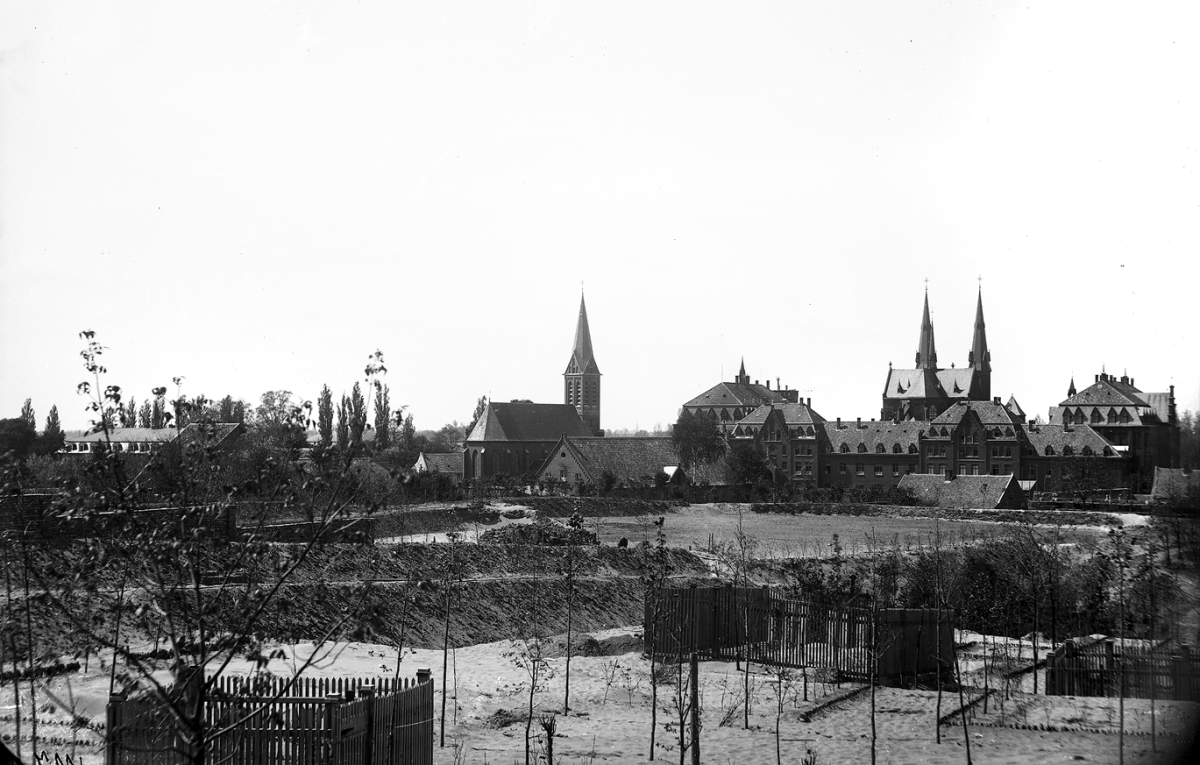
Object of the month
Steyl: from a village on the Meuse to an international mission village
Steyl lies on the banks of the Meuse, between Venlo and Tegelen. Today, the village is best known for its historic monasteries, historic buildings and unique religious heritage. Yet Steyl’s history did not begin with the Church. For centuries, Steyl was a place where trade, shipping and industry shaped daily life. This was due to its favourable location on a bend in the Meuse. It was not until the end of the nineteenth century that the village took on a different character. With the arrival of the German priest Arnold Janssen, Steyl developed into an international centre for the Catholic mission. From this small Limburg village, missionaries were trained and contacts were maintained with regions all over the world.
From trading post to monastic village
Its location on the River Meuse played a significant role in Steyl’s development, as it formed a link between various trading posts. From the seventeenth century onwards, Steyl increasingly took on the character of a trading settlement. Trade brought prosperity and attracted wealthy families. They had large houses built, some of which can still be admired today. The wine trade was one of the activities that contributed to this economic development.
In the nineteenth century, circumstances changed. New means of transport, including the railway, made overland trade routes more attractive. The traditional importance of the Meuse as a transport link gradually declined. It was precisely during this period that Steyl took on a new purpose, in which its location near the German border would play a decisive role.
Arnold Janssen and the SVD
In the second half of the nineteenth century, relations between the Catholic Church and the German state were strained. Under Chancellor Otto von Bismarck, the German government waged the Kulturkampf. Through this campaign, the government sought to limit the social and political influence of the Catholic Church, amongst other things by making it more difficult to establish monastic communities.
For the German priest Arnold Janssen (1837–1909), this situation provided the impetus to realise his ambition just outside Germany. Thus, in Steyl, he founded his training institute for men who wished to dedicate themselves to spreading the Catholic faith to other parts of the world. A modest start in a former inn laid the foundations for a new missionary community for priests and brothers: the Societas Verbi Divini, or the Society of the Divine Word. In 1879, the first SVD missionaries set off for China. Later, their reach was extended to other parts of the world.
Blue and Pink Sisters
But the brothers could not do it alone. The growth of the SVD community created a need for female missionaries, who, through their work in education,
healthcare and religious instruction, would come to play an important social and community role in their mission territories. Several women were already involved in the day-to-day life of the mission house, and in 1889 Janssen, together with Maria Helena Stollenwerk and Hendrina Stenmans, founded the Congregation of the Servae Spiritus Sancti (Servants of the Holy Spirit). Seven years later, a third religious community was established: the Servae Spiritus Sancti de Adoratione Perpetua, also known as the Servants of the Holy Spirit of Perpetual Adoration. These sisters are known as the Pink Sisters and have chosen a contemplative life. Their religious vocation consists of perpetual adoration, in support of the missionary work of the other two congregations in Steyl.
Communities from all over the world
The missionaries travelled to destinations including China, Japan, Indonesia, Papua New Guinea, various African countries and South America. From the very start of their missionary activities, artefacts and natural history specimens were sent from the mission fields to Steyl. The Mission Museum houses the many objects collected by the SVD missionaries; the Blue Sisters have their own museum.
The collection served various purposes, such as familiarising future missionaries with the areas to which they might be sent. At the same time, it gave visitors to Steyl the opportunity to learn about other parts of the world. At a time when photography, film and international communication were still limited, such collections were an important source of information and visual representation. In almost a hundred years, the way in which the brothers have made their collection accessible to the public at the Mission Museum has hardly changed. As such, the way the collection is presented offers an insight not only into the SVD’s collecting practices, but also into the way in which the world was viewed and presented from a European missionary perspective in the last century. This gives the Mission Museum a special historical value.
Today
Anyone walking through Steyl today finds themselves in a village where different eras coexist. Old trading houses serve as a reminder of the time when the River Meuse allowed economic life in Steyl to flourish. The monasteries, churches and gardens tell the story of the religious communities that further shaped the village. They brought Steyl to the world and the world to Steyl. As such, Steyl is a special part of Limburg’s heritage and a tangible reminder of times gone by.