Object of the month
The Epic Tale of Hanuman
In several places throughout the Mission Museum, there are objects that harbour beautiful, impressive or exciting stories. This is also true of this print, which is displayed rather inconspicuously at the end of a wall in the India display case.
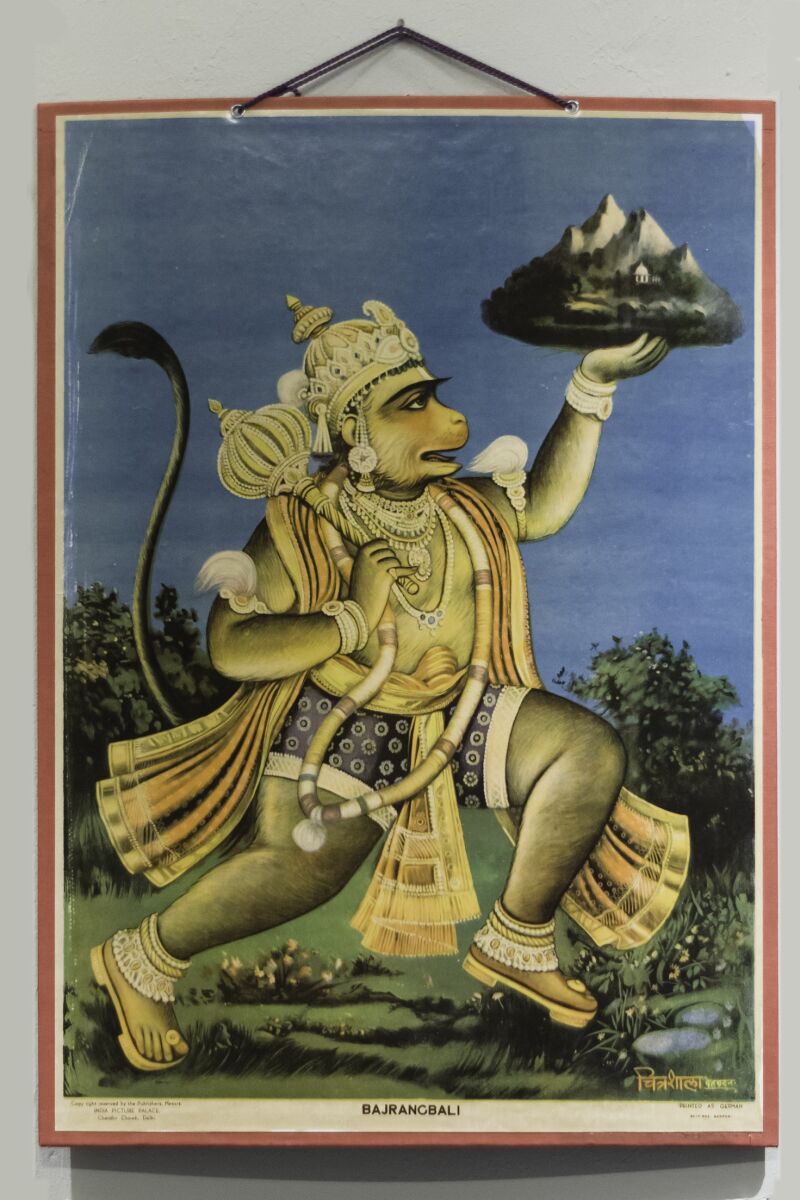
This print depicts a dramatic scene from the epic Ramayana, which tells the story of Prince Rama, his brother Lakshmana and Rama’s wife Sita. When she is abducted by the demon king Ravana, Hanuman – the figure in the print – helps to search for and rescue her. Hanuman is a loyal ally of Rama and is depicted as a monkey general with a human body, a monkey’s head and a monkey’s tail.
During the battle with the demon king, Rama’s brother is seriously wounded. To save Lakshmana, a medicinal herb is needed that grows only on a mountain in the Himalayas. Hanuman is tasked with fetching the herb. Unable to recognise the correct herb and with time running out, he uproots the entire mountain and flies back to the battlefield with it. This enables Lakshmana to be saved. This epic tale highlights various qualities associated with Hanuman: extraordinary strength, courage, loyalty and bhakti; devoted love for a deity. A similar depiction of Hanuman is held in the collection of the Metropolitan Museum of Art in New York.
The dissemination of religious imagery
As well as the story it depicts, this print in the Mission Museum’s collection is also of interest because of the way in which religious images were produced and disseminated in modern India. From the second half of the nineteenth century onwards, new printing techniques made it possible to produce images (of Hindu deities) in large print runs and at relatively low cost. Religious images no longer existed solely as paintings, sculptures or other forms of temple art; as prints, they could also be displayed in domestic settings.
From the end of the nineteenth century, a substantial market emerged in India for printed images of gods, goddesses and scenes from religious stories. In this way, prints became part of the religious visual culture outside the temple. Many examples of this print culture have also found their way into European museum collections.
From religious depiction to museum object
The Hanuman print in the Mission Museum thus tells several stories at once. First and foremost, that of Hanuman himself: a deity who, in the Ramayana, symbolises strength and unconditional devotion to Rama. Furthermore, the print illustrates how religious images, through modern printing techniques, became part of an ever-widening commercial visual culture in India.
As soon as the print was placed in the display case, it took on a new context. This object became part of a collection intended to introduce visitors and novice missionaries to religions and cultures outside Europe. In addition to its role as a religious image,
the print took on the function of educational material. It is partly this shift that makes this object so interesting. The print tells us something about Hinduism and the way in which religious images were created and used in India, but also about the European perspective through which such objects were collected and subsequently presented in a museum.
With thanks to Jasper Sijben
Photo: Bart Beurskens